verification management systems
Home
Why VMS
Meet the team
verification management systems
Home
Why VMS
Meet the team
More
  • Home
  • Why VMS
  • Meet the team

  • Home
  • Why VMS
  • Meet the team

vms digital preventative maintenance inspection test program

VMS PMITP

VMS PMITP – Digitally Managed Preventative Maintenance, Inspection & Test Programs tailored to each equipment type. Integrated directly with First Pass Verification (FPV) and SITEPASS, PMITP ensures every asset meets its specific certification, testing, and maintenance requirements before mobilisation. PMITP is based on industry best practice.

Design of First Pass Verification (FPV)

Design of First Pass Verification (FPV) – A structured, AI-powered review process that validates supplier documentation against PMITP and Safety Case requirements before TPI engagement. By catching errors early, FPV eliminates costly rework, reduces inspection delays, and ensures equipment arrives on-site ready for mobilisation. 

AI Optical Character Recognition (OCR) features

Manual document checking is time-consuming, error-prone, and a major contributor to inspection delays. VMS-REPLM+ changes that with our purpose-built AI Optical Character Recognition (OCR) engine, purpose-built for the oil and gas equipment verification environment. 

First Pass Verification (FPV) process
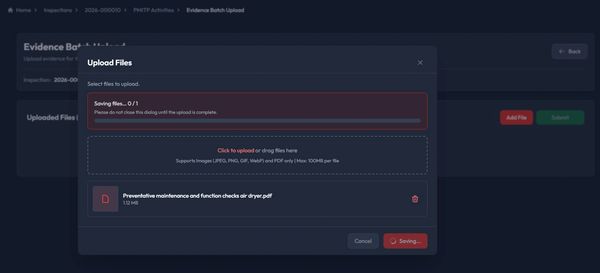
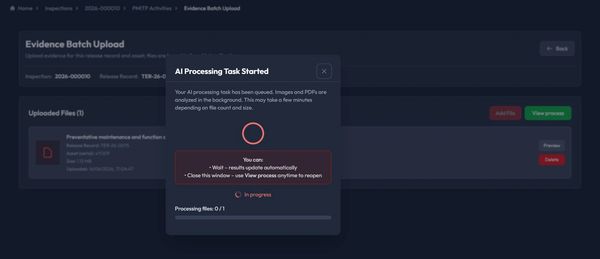
Step 1: Document Ingestion

  •  Suppliers are notified via email automation that they are ready to upload QC records, certificates, test reports, Material Test Reports (MTRs), Certificates of Conformance (CoCs), NDE reports, and other compliance documentation directly into the VMS portal.
  • Documents can be uploaded in multiple formats (PDF, JPEG, PNG, TIFF)

Step 2: Intelligent Data Extraction

 The OCR engine scans each document and extracts key data fields, including:

  • Equipment serial numbers and asset IDs
  • Certificate numbers and issuing bodies
  • Issue and expiry dates
  • Test dates and pressure test results
  • Material grades and chemical/physical properties
  • NDT/NDE results (MT, PT, UT, RT)
  • Manufacturer and supplier details

Step 3: Automated Validation Against PMITP

Extracted data is automatically cross-referenced against the PMITP requirements for that specific equipment type. Types of system checks:

  • Is the certification valid and unexpired?
  • Does the serial number match the asset?
  • Are test pressures and results within specification?
  • Is the material grade suitable for the intended service?
  • Has all required NDT/NDE been performed and documented?

Step 4: Real-Time Compliance Feedback

  • Results are instantly displayed to the supplier
  • Confident Scores 0-100% based on OCR result on verification and configuration inspection activity process. 
  • Human review allows changed to inspection activity allocation and record classification to improve confident scores.
  • Once submitted the results are uploaded to the VMS PMITP ready for independent audit

Key Benefits with vms pmitp ocr and fpv optimisation

  • Eliminates manual data entry – no more spreadsheets or hand-checking
  • Faster document processing – seconds, not hours or days to review
  • Reduces human error – consistent, repeatable validation every time
  • Accelerates FPV – suppliers receive instant feedback on results
  • Full audit trail – every document and validation result is recorded
  • Reduces TPI costs – fewer delays, less rework, lower NPT onsite.

Frequently Asked Questions

Please reach us at contact@vms-int.com if you cannot find an answer to your question.

 The AI OCR engine has been specifically trained on oil and gas industry documentation formats and achieves an accuracy rate of over 99% for clearly formatted documents. For documents with poor quality, unusual formatting, or handwritten entries, the system flags these for human review—ensuring that no critical data is missed. Additionally, the system continuously learns and improves as it processes more documents over time. 


No. The AI OCR process is designed to augment and enhance human inspection, not replace it. It handles the time-consuming, repetitive task of document validation—freeing up inspectors to focus on high-value activities like physical inspection, technical assessment, and complex decision-making. The system flags exceptions, identifies non-conformances, and ensures that only properly documented equipment reaches the inspection stage, significantly reducing NPT and rework. 


Traditional TPI often involves inspectors spending significant time on administrative tasks—searching for missing documentation, verifying serial numbers, checking expiry dates, and flagging non-conformances. This wasted time is costly (often charged at premium rates) and delays.

FPV AI OCR addresses this by:

  • Catching errors early – before the inspector arrives
  • Eliminating administrative delays – documents are pre-validated
  • Reducing rework – suppliers fix issues upfront
  • Reducing TPI attendance hours – inspectors arrive when equipment is truly ready

Clients typically see 30–50% reductions in TPI costs.


The AI OCR processing time is typically 5–10 seconds per document. However, the overall FPV timeline depends on the supplier's responsiveness in correcting any identified issues. In practice, FPV reduces total document review time from days or weeks to hours, significantly accelerating the mobilisation timeline. 


Yes. The AI OCR validation rules are fully configurable to your:

  • PMITP templates
  • Safety Case requirements
  • Client-specific specifications (e.g., Shell DEP, Chevron Standards, INPEX Specifications)
  • Equipment classifications and categories
  • Regulatory requirements (NOPSEMA, AMSA, MODU Code, Class Society rules)

Our team works with you to define the validation logic that matches your specific operational requirements.


  • Home

VERIFICATION MANAGEMENT SYSTEMS

USA | AUSTRALIA

Copyright © 2026 VMS - All Rights Reserved.

Powered by davicra

This website uses cookies.

We use cookies to analyze website traffic and optimize your website experience. By accepting our use of cookies, your data will be aggregated with all other user data.

DeclineAccept